In this post
Observation helps practitioners understand how children grow and learn.
It involves watching children play, talk and explore to uncover their unique interests, strengths and emerging skills. Practitioners often jot down brief notes – quick written snapshots of what a child did or said. These notes provide a more reliable record than memory alone and help shape future planning. For example, a child who repeatedly pours water from one container to another may be showing curiosity about early mathematical ideas linked to volume and capacity.
Observation also supports inclusion as it can highlight when a child may need extra help or small adjustments. A child who avoids busy spaces may be finding noise overwhelming; in this case, a quiet, cosy corner can offer comfort. For children who are not yet speaking, noticing how they make choices can guide practitioners towards visual cues or simple signs that ease communication.
Looking back over observation notes, whether individually or in team discussions, encourages reflective practice. It helps practitioners spot patterns in their approach. For example, you might notice that you tend to focus on the most confident children, which reminds you to look more closely at those who are quieter or prefer to watch before joining in. Reviewing and adjusting helps keep practice fair and responsive.
Observation also supports children’s well-being. Subtle changes – such as a child becoming withdrawn or losing interest in familiar activities – can be picked up early when adults are paying attention and keeping notes. Sharing these observations with families or other professionals can open helpful conversations and, when needed, enable the child to get support.
This article looks at the different ways practitioners can observe children and use what they notice to support learning. It explores practical techniques, how these link with the Early Years Foundation Stage (EYFS) guidance and simple ways to involve families. The aim is to show how everyday observations can shape thoughtful, responsive practice.
Observation as part of everyday EYFS practice
Under the Statutory Framework for the Early Years Foundation Stage (EYFS, 2021), observation and assessment are expected parts of daily practice. They help practitioners understand how children are progressing across the seven areas of learning and shape decisions about what to offer next.
The following are key statutory touchpoints:
- Formative assessment – practitioners use day-to-day observations to understand what children can do and what may help them move forward. These insights guide planning.
- Progress check at age two – a short written summary of a child’s development in key areas is shared with parents and, when helpful, health professionals. This check draws on observations gathered over time so that strengths and any emerging concerns are recognised early.
- Reception baseline assessment (RBA) – all children complete the RBA at the start of the Reception year. Although it sits alongside ongoing observational assessment rather than replacing it, the information can help build a rounded picture of early learning.
- Early years foundation stage profile (EYFSP) – at the end of Reception class, practitioners make judgements for each Early Learning Goal. These decisions are based on what they have seen children do in everyday situations over time.
Ofsted expectations and quality assurance
Ofsted looks at how well observation is being used in education settings. Inspectors want to see that observations genuinely inform teaching and care – that practitioners notice what children are doing, use this information to shape next steps and can explain how these decisions support progress.
You can demonstrate this through simple records, team discussions or moderation activities that help staff build a shared picture of children’s development.
Data protection and confidentiality
Observation records often include personal information, so they must comply with UK GDPR.
Notes, photos and videos should be stored securely with clear access controls. Consent from parents or carers is needed for images or recordings, and settings should have straightforward policies explaining how long records are kept and what happens when children move into the next school year.
Anecdotal records – capturing spontaneous moments
Anecdotal records are short notes that capture meaningful moments as they happen. They allow practitioners to be flexible. For example, they can jot down observations during play without interrupting children.
Here are the key approaches:
- Precision – write down what was said or done as closely as possible. For example, “Logan balanced three pebbles on the block, then added a fourth and whispered ‘Don’t fall’”.
- Contextual detail – include the date, time, place and any adult involvement so the moment can be understood later.
- Objectivity – note only what you see and hear rather than guessing motives or feelings.
- Accessibility – keep entries short (three sentences max), and save them somewhere easy to find.
Storage and retrieval
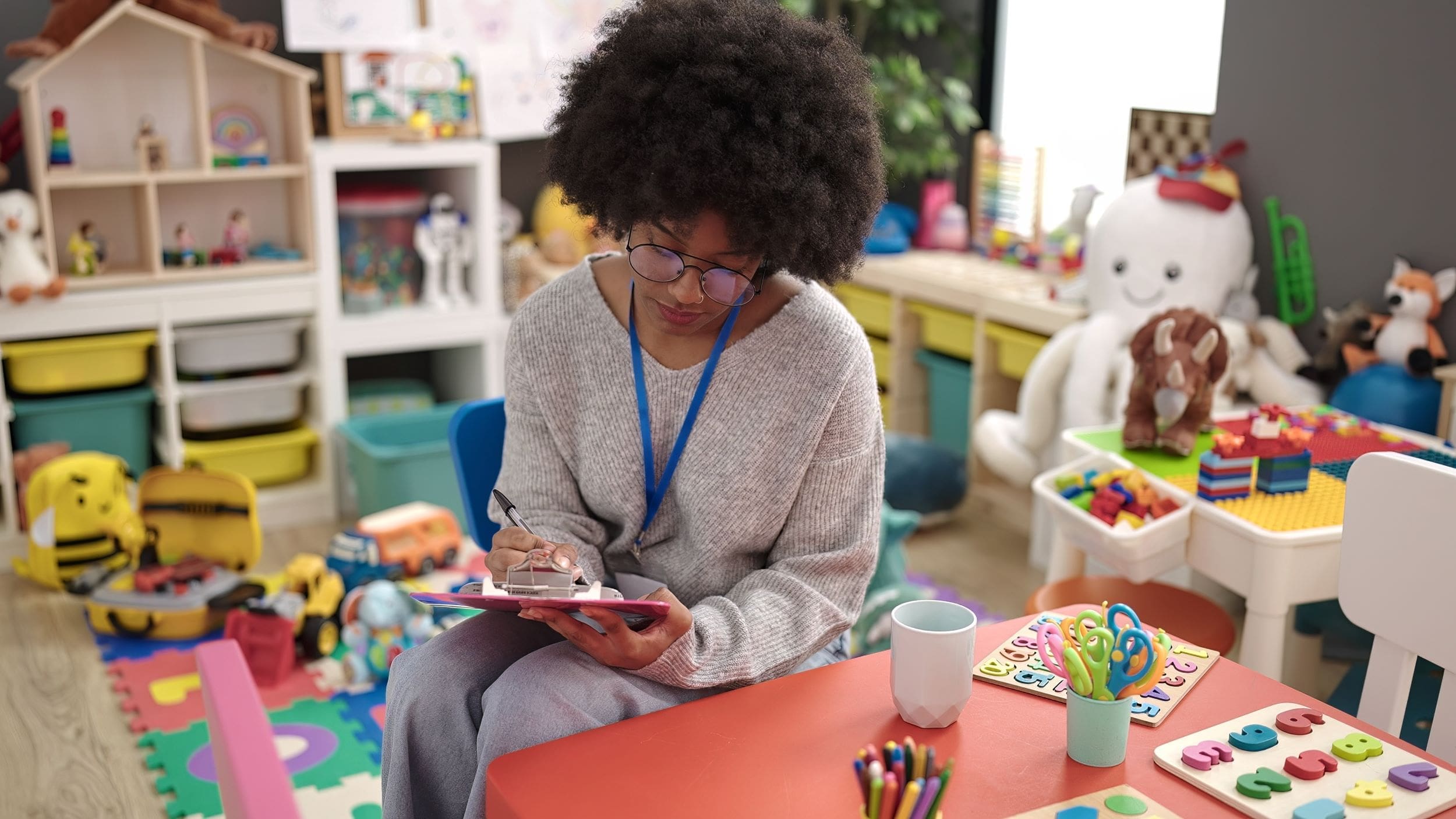
Anecdotal notes can be kept on paper or in digital systems. Either way, it’s important to use a simple, consistent method. For example, you might organise notes by child and term, or sort them by area of learning. Clear labelling and regular checks help keep records easy to find and GDPR-compliant.
When notes are stored in an organised way, it becomes much easier to spot useful patterns. Practitioners can quickly pull together related observations to see how a child’s interests or skills are developing, which in turn supports planning and decision-making.
Running records – detailed narrative notes
Running records offer a continuous account of what a child or small group does over a short, defined period. Typically lasting 5–10 minutes, they help practitioners see how learning unfolds moment by moment – how children approach a task, communicate with others and manage their emotions.
How to conduct running records effectively
- Select focus and context – choose a child or group to focus on, or select a setting such as free-flow play or small-group storytelling.
- Timeframe – aim for 5–10 minutes. This lets you collect rich detail while keeping the record manageable.
- Notation system – use simple codes (e.g., C for child, P for peer, A for adult) alongside shorthand for frequent actions, such as “CL” for climbing.
- Objective recording – write only what you see and hear. You can interpret this later.
A short extract might look like:
“14:05–14:10: C kneels by water tray, scoops water into sieve, watches droplets fall. P joins, C offers sieve, says ‘Your turn’. They count together ‘One-two-three’. C uses pipette, looks closely at droplet under magnifier, whispers ‘Tiny world’. A asks, ‘What do you notice?’ C replies ‘Little stones like stars’”.
Using running records across different areas of learning
Running records are helpful for capturing subtle aspects of learning. Here are some examples:
- For communication and language, you can note vocabulary choices, sentence patterns and turn-taking.
- When looking at personal, social and emotional development, records may show how children share, manage tension or empathise with others.
- For physical development, noting the order of actions – climbing, pouring or drawing – shows what the child can manage and where a small change might help. This could be offering a different tool or adjusting the height of a table to give more stability.
Analytical reflections
After writing the narrative, it can be helpful to reflect on:
- Learning dispositions – does the child show curiosity, persistence or cooperation?
- Environmental influences – how did the space or resources shape their play?
- Next steps – what experiences might build on this moment?
These reflections help guide your planning, and you can share them in team discussions to build a shared picture of progress across the group.
Time sampling – structured interval observations
Time sampling involves checking at regular intervals to see if a particular behaviour is happening at that moment. These quick observations help practitioners spot simple patterns, such as when a child is most engaged, which activities they choose most often or how long they stay focused.
- Define the target behaviour – choose a clear, observable action such as independent mark-making, turn-taking or focused listening.
- Set intervals – decide when to check in, often every one to five minutes.
- Prepare a grid – list time slots along one axis and children’s initials or behaviour categories along the other.
- Record systematically – at each interval, note presence (✓) or absence (X)
For example, with three-minute check-ins, you might find that a child is deeply engaged 8/10 times. This pattern could prompt you to extend the activity, add new tools or offer similar open-ended challenges elsewhere.
Applications for self-regulation and attention
Time sampling can show how children handle moments when they need help or feel overwhelmed.
You might note whether they ask an adult for support, take themselves to a quieter space or try a simple calming strategy. Looking at these notes over time makes it easier to see if they are becoming more independent – for instance, needing fewer reminders once emotion cards or other visual supports are in place.
Analysing and visualising data
When the sample period ends, the marks can be tallied and viewed over several days or weeks. Simple bar charts or line graphs, even hand-drawn, can highlight trends that support conversations during discussions with parents or your team. These visuals make progress easier to share and can help identify when more focused support is needed.
Event sampling – focusing on significant incidents
Event sampling records every time a specific behaviour occurs. Rather than observing at set intervals, you can note each instance as it happens. This approach is helpful for behaviours that are important but irregular – such as moments of empathy, conflict or risk-taking.
- Specify the event – define exactly what you’re looking for (for example, “initiates sharing of resources” or “seeks help after frustration”).
- Observation window – choose when you will observe the child, such as during outdoor play or transition times.
- Record immediately – use a simple event log to note date, time, participants, antecedent and response.
A short entry might read:
“12th March, 9.45am, outside: J noticed T crying after a fall, ran to get a tissue, offered comfort and asked ‘You okay?’, then told an adult.”
Event sampling for safeguarding
You may notice concerning behaviors, like repeated emotional outbursts or social withdrawal. In these cases, event sampling can help build an objective picture. Looking at what leads up to the behaviour and what happens next (the ABC model) helps identify triggers and shape supportive responses.
Linking to EYFS learning goals
Connecting recorded events to EYFS areas of learning, such as personal, social and emotional development, helps you plan next steps. More frequent sharing might suggest a child is ready for small cooperative projects, while repeated conflicts could indicate the need for turn-taking games or focused support.
Checklists & rating scales – quick-reference assessment
Checklists and rating scales give a simple overview of a child’s progress across a range of skills. You can use them to spot patterns at a glance and help ensure everyone on the team assesses the child in the same way.
To create checklists or rating scales that produce consistent, meaningful information, it helps to think carefully about how each scale is designed.
- Choose focused items – base each entry on an EYFS skill and describe only what can be seen, for example, “uses three-word sentences” or “balances on one foot for three seconds”.
- Select a scale that fits – decide how precisely you want to track progress, for example, a simple three-step scale (emerging/developing/secure) or a five-step scale for more nuance.
- Clarify what each point means – provide short examples for each step of the scale so staff have a shared sense of what counts at each level.
- Review as a team – look at completed examples together to compare thoughts, talk through tricky items and agree on a common standard.
Balancing quantity with quality
Checklists can be completed quickly and give a useful overview of a whole group. However, they work best when combined with narrative notes, photos or video clips. Without this extra context, important details may be lost. A child may show strong physical skills in a familiar garden but need support in a new space. Narrative records would help explain why.
Using technology for scoring
Many digital systems allow settings to build their own checklists and link entries to EYFS statements. These tools can produce simple charts that show progress over time. Clear routines around storage and review are important so that information remains purposeful.
Visual evidence – photo and video documentation
Photos and short video clips can help capture details that written notes might miss. For example, you can record a child’s expression as they solve a problem, a moment of teamwork or the steps they take during a creative task.
With this kind of evidence, there are ethical and consent considerations:
- Parental permissions – obtain written consent that explains how images may be used.
- Privacy respect – avoid photographing children in sensitive situations and blur or crop other children for whom you don’t have consent.
- Secure storage – it’s crucial that these files are stored safely, on encrypted devices or GDPR-compliant platforms with clear access rules.
There are some ways you can maximise the learning impact of videos and photos:
- Annotations – add simple notes to the material you collect. For example, you might write the date and time, summarise context and share early thoughts about the learning.
- Sequenced portfolios – group images in order so it’s easy to spot changes over time, like block play developing from single towers to more detailed constructions.
- Slow motion or time-lapse – use these tools to examine social exchanges or movement skills more closely, and share clips in professional conversations to support next steps.
Professional development applications
Video is also useful for staff learning. Watching short clips together helps teams notice things they may miss in the moment, such as how an adult gives space for a child to speak or the way a prompt is offered. Talking this through as a group builds shared understanding and helps everyone keep developing their practice.
Learning stories – child-centred reflective narratives
Learning stories celebrate a child’s interests, actions and growing confidence by drawing observation and narrative together. They give families and practitioners a more personal view of learning, showing not only what a child can do but how they approached the experience.
- Choose a simple heading that sets the scene, such as Hannah’s rainbow adventure.
- Describe what happened, including setting and direct speech, for example, “Hannah dipped the brush, murmured ‘Green like grass’, then paused before choosing her next colour”.
- Link the story to the “Characteristics of Effective Learning”, such as curiosity, resilience and critical thinking.
- Add the child’s own words or drawings to reflect their viewpoint.
- Suggest gentle opportunities to build on the moment, such as exploring colour mixing outdoors or collecting leaves for painting.
Involving the child’s voice
Inviting children to revisit and add to their learning stories brings them into the process so that they can recognise their own progress and build confidence in talking about their learning. For example, they might comment on what they enjoyed most, add drawings or choose photos to include.
Building holistic profiles
Learning stories sit comfortably alongside other assessment tools, adding colour and personal context. When you put them together with checklists, time-sampling notes and digital portfolios, they help you understand what a child can do, what sparks their interest and how they like to learn.
Digital observation tools – apps and platforms
Digital tools streamline documentation, analysis and communication.
Here are some key platforms for UK settings:
- Tapestry – widely used for multimedia observations linked to EYFS statements, with a parent portal and downloadable reports
- Famly – combines observations, meal tracking and messaging to support day-to-day communication with families
- Evidence Me – offers custom checklists and automatic EYFS links to support assessment
- EY Log (by Eyworks) – uses tags and dashboards to help staff track trends
- Kinderly Together – observation, reporting and family-sharing features with CPD resources
- Blossom Educational – observation, assessment and parent communication tools
- iConnect and ParentZone (by Connect Childcare) – digital observation and family-linked reporting (more common in larger nursery chains)
Digital systems only really help when everyone feels confident using them. Many settings offer shared tablets or give families a chance to borrow a device if needed, and a short, simple walk-through is often enough to help staff feel comfortable adding observations or tagging learning.
It’s also worth checking regularly that data is stored safely and deleted when no longer needed. This reassures families that their information is treated with care.
Most importantly, technology should support your time with children, not distract from it. Quick notes, a photo or a brief tag are usually all that’s needed in the moment, after which the device can go away again. Some practitioners keep a small paper prompt in their pocket or use a “note now, review later” feature to avoid long stretches of screen time. This keeps interactions warm, keeps the focus on the child and still gives you the information you need for thoughtful assessment.
Engaging families – sharing observations with parents
Strong partnerships between the child’s home and their nursery or school amplify learning and enable everyone to follow a consistent approach in different environments.
Here are some best practices for tailoring communications:
- Jargon-free summaries – explain observations in clear, everyday language, for example, “Your child enjoyed building tall towers today, showing early spatial thinking”.
- Multilingual support – if needed, you can offer key messages in home languages using translation tools or bilingual staff.
- Varied channels – use a mix of digital updates, short paper notes, phone calls and face-to-face conversations to reach all families.
Families often notice interests or skills that the child may not show you in school or nursery. Examples include new words, a sudden interest in lining up toys, an emerging fascination with water play or early attempts to dress themselves. Inviting parents to share moments from home helps build a fuller picture of each child. These contributions can be added to learning portfolios.
Agreeing on simple next steps together, such as “practise cutting with child-safe scissors twice a week”, encourages shared responsibility and helps families feel confident about how to support the child’s learning.
Termly open sessions, such as “stay and play” or small exhibitions of children’s work, give families time to explore portfolios and speak to teachers and practitioners. These relaxed occasions build trust, prompt rich conversations about progress and help families feel closely connected to their child’s journey.
From observation to planning – analysis & next steps
Observation is a starting point. Its value comes from using what we see to shape meaningful experiences for children.
Synthesising multimodal data
To move from notes to action, you need to pull together different types of evidence – brief anecdotes, longer narratives, photos, video clips and checklists. Looking at these as a whole helps reveal patterns in children’s learning, rather than treating each record in isolation.
Here are three simple ways to organise this information:
- Portfolio reviews – look across recent records to spot shared themes or interests, such as repeated construction play or growing confidence in speaking.
- Thematic analysis – group observations under broad headings such as communication, physical skills or independence, noting areas of strength and aspects that may need more attention.
- Cohort profiling – use simple charts or digital tools to visualise trends across the group, for example, strong number recognition alongside developing fine-motor control.
Once needs are clearer, create goals that are specific, measurable, achievable, relevant and time-bound – SMART. For example: “By the end of term, Ibrahim will use two-handed tools, such as scissors and glue sticks, to cut and stick simple shapes in three out of four craft sessions.”
Plan experiences that speak directly to the agreed objectives. You might set up a cutting table with different paper textures, offer playful scissor games using laminated shapes or model safe tool handling. Think about layout, too. Resources placed within reach help children explore independently and build confidence.
Short weekly check-ins give teams space to share new observations, adjust groupings or shift adult roles. Families can be invited to contribute ideas and celebrate progress, keeping everyone connected. Peer observations – even brief room swaps – bring fresh perspectives and spark helpful conversations about practice.
Summing up
When observations feed directly into everyday decisions about activities, routines and support, children learn in a way that genuinely reflects who they are. Over time, small insights gathered day by day can grow into rich pathways that help children become confident, curious and capable learners.